
AI Identity Security & Compliance in 2026: Securing Agentic AI Workflows
1. Future of AI agents in Compliance and Security
The enterprise landscape is undergoing a groundbreaking shift, transitioning rapidly from experim
ental Large Language Model (LLM) pilots to the deployment of production ready “Agentic AI.” While the first wave of AI was characterized by chatbots that summarized text or answered queries the agentic wave introduces autonomous actors. These systems possess the capability to reason, plan, access multi platform data, and execute complex workflows across the enterprise stack without constant human prompting.
AI agent security and ethics risks in 2026:
For the Chief Information Security Officer (CISO) and Lead Compliance Architect, this shift represents a new frontier of risk. According to recent industry data, 91% of organizations are currently deploying autonomous agents, yet the governance infrastructure has failed to keep pace. Nearly half of these organizations lack formal oversight for their AI deployments. This governance gap is not merely a technical oversight; it is a critical vulnerability that breaks the chain of custody required for SOC2 and ISO 27001 compliance.
The central thesis for modern security leadership must be this: Identity is the new perimeter for AI security. The traditional network-centric security model is fundamentally ill equipped to manage autonomous entities that traverse cloud, SaaS, and internal data silos. To scale AI safely and meet global regulatory demands, enterprises must treat agents as high priority. This means applying the same rigorous standards authentication, fine grained authorization, and automated lifecycle management to AI agents as we do to human users.
Autonomous AI agent workflow automation
2. The Problem: Shadow AI and the Risks of Unmanaged Agents
The rise of “Shadow AI” the unauthorized deployment of AI tools and agents by business units creates invisible entry points for attackers. These unmanaged agents often operate with excessive permissions, serving as a silent bridge between public LLMs and sensitive internal data. Without a unified identity strategy, the damage caused by a single compromised agent can be catastrophic.
The risks of unmanaged agents can be categorized into three primary strategic threats:
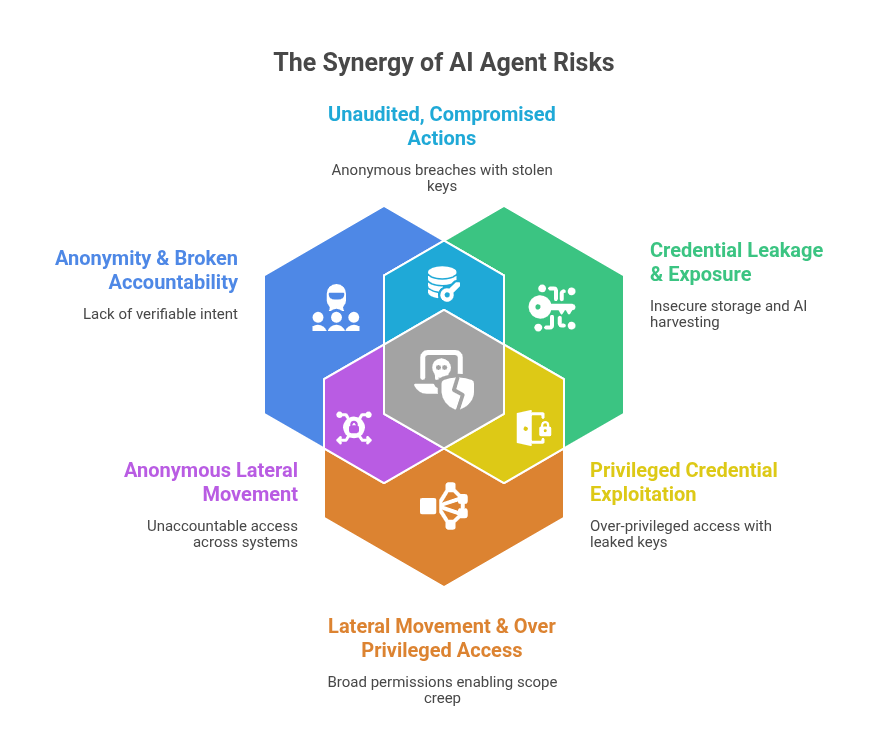
- Anonymity of Agents and Broken Accountability: Many agents currently operate under shared, generic identities or service accounts. When multiple agents or users share a single set of credentials, the “chain of intent” is severed. From a compliance perspective, this makes it impossible to provide a proof of intent. Without a verifiable link to a human initiator, organizations cannot audit specific actions or hold individuals accountable during a forensic investigation.
- Credential Leakage and Exposure Vectors: In the absence of centralized management, developers often resort to storing API keys and OAuth tokens in insecure configuration files or source code. This creates a high risk of credential leakage into system logs. Perhaps more uniquely to AI, these credentials can be surfaced in LLM conversational outputs via prompt injection or logic errors, where they can be harvested by malicious actors.
- Lateral Movement via Over Privileged Access: The “status quo” for many AI integrations is a broad, “all-or-nothing” read access to enterprise knowledge bases and databases. Because agents are often granted service level permissions, a single compromised agent can move laterally across SharePoint sites, databases, and SaaS platforms that are far outside its intended functional scope.
How to build an AI agent from scratch securely
3. Pillar One: Securing Production-Ready AI Agents
To transition AI from a risky experiment to a production ready asset, security leaders must move toward identity-centric controls. This ensures that every agent interaction is tied to human intent and remains fully trackable and auditable.
3.1 Authentication & Verified Human Intent
The foundation of agent security is the rejection of anonymous or shared service accounts. Enterprises must enforce sign-in via standard protocols such as OIDC (OpenID Connect) and OAuth 2.0. By mandating these protocols, organizations ensure that every agent session is initiated by a verified human identity. This established “linkage” ensures non-repudiation; an agent cannot perform an action unless a human user has been authenticated and their intent has been programmatically verified. This is the first step in ensuring that AI agents do not become “ghosts in the machine” acting without oversight.
3.2 Token Vaulting and Credential Hygiene
Traditional AI deployments often leave sensitive credentials exposed in the application’s execution context. A CISO-level best practice requires a transition to Token Vaulting. This involves offloading OAuth tokens for third-party applications, APIs, and specifically Model Context Protocol (MCP) servers into a dedicated, secure vault.
MCP represents a significant new vector: it is the protocol that allows agents to connect to various data sources and tools. If an MCP server’s credentials are leaked, the agent’s ability to manipulate data across disparate systems is compromised.
Status Quo vs. Best Practice
- Status Quo: Static credentials stored in configuration files or code; tokens are exposed in logs and LLM outputs; rotation is manual and infrequent.
- Best Practice (The Goal): Tokens are stored in a dedicated vault; the system issues only short-lived access tokens. Sensitive credentials remain outside the agent’s execution context. A centralized policy enforces a 90-day rotation cycle (at minimum) to limit the exploitation window of any compromised secret.
3.3 Fine-Grained Authorization (FGA) and RAG
Retrieval-Augmented Generation (RAG) is one of the primary method by which agents access enterprise data. However, RAG systems frequently suffer from “over-privilege,” where an agent has access to the entire repository even if the user does not.
To solve this, organizations must implement Fine-Grained Authorization (FGA). This involves relationship-based authorization that tethers RAG retrieval to the specific permissions of the authenticated human user. For example, in a “Status Quo” scenario, an agent might have read access to an entire SharePoint directory. In an FGA-enabled environment, the agent can only retrieve snippets of data that the human user is explicitly authorized to see in the underlying IAM policy. By mapping agent scopes to human permissions, you eliminate the risk of privilege escalation.
3.4 Human-in-the-Loop & Token Exchange
For high-impact or sensitive operations, autonomous action introduces unacceptable risk.
- Human-in-the-Loop: Using CIBA (Client-Initiated Backchannel Authentication) and RAR (Rich Authorization Request), the system can push real-time, out-of-band approval requests to a user’s mobile device. If an agent attempts to execute a transaction exceeding $1,000 or delete a critical database, it is paused until the human provides an explicit “okay.” This creates a verifiable audit trail for compliance teams.
- Token Exchange: As an agent moves across different trust domains calling a CRM API and then a financial database the “chain of identity” often breaks. Token Exchange protocols share the user’s identity securely across these domains, maintaining a verifiable link between the agent’s downstream actions and the human user who authorized them.
- Pillar Two: Governing Agents through a Unified Control Plane
Enterprise security cannot be achieved through siloed AI tools. A unified control plane provides the centralized visibility necessary to govern the end-to-end lifecycle of every agent.
4.1 Discovery and the Agent Registry
Visibility is the precursor to control. The first step in governance is Agent Detection the automated discovery of rogue agents across cloud and SaaS platforms. Once identified, these agents must be onboarded into a central Agent Registry within the enterprise user directory.
Each entry in the registry must include:
- A Unique Identifier: For precise tracking across logs.
- A Designated Human Owner: To ensure accountability for the agent’s actions.
- Documented Purpose: A clear definition of what the agent is allowed to do, which serves as the baseline for anomaly detection.
4.2 Automated Lifecycle Management: Cradle-to-Grave Governance
Managing AI agents requires a “cradle-to-grave” approach to ensure they do not become orphaned entry points for attackers. This automated lifecycle includes:
- Automated Onboarding: When a new agent is deployed, it must be automatically assigned an identity and a set of least-privilege permissions based on its documented purpose.
- Access Reviews and Certifications: Permissions must not be static. Periodic, automated reviews must validate that an agent’s access remains aligned with its current tasks. If an agent was granted access to a project folder that is now closed, that access must be revoked.
- Right-Sizing: Using analytics to ensure permissions are not broader than the agent’s actual usage patterns.
- Removal of provisions: Stale or obsolete agents are often the weakest link. Automated deprovisioning ensures that once an agent’s task is complete, its identity and all associated tokens are revoked across the entire environment.
4.3 Rapid Containment with Universal Logout
In a threat scenario, the speed of containment determines the severity of the breach. A unified identity platform must support Universal Logout. This technical capability allows security teams to trigger an immediate, cross-system revocation of all active sessions and access tokens for a specific agent. By cutting off access instantly across integrated SaaS and APIs, organizations can stop lateral movement in its tracks while preserving detailed logs for forensic analysis.
- Comparing Approaches: Traditional vs. Unified Identity Platforms
The following table contrasts the risks of legacy identity management with the strategic capabilities of a unified identity platform designed for Agentic AI.
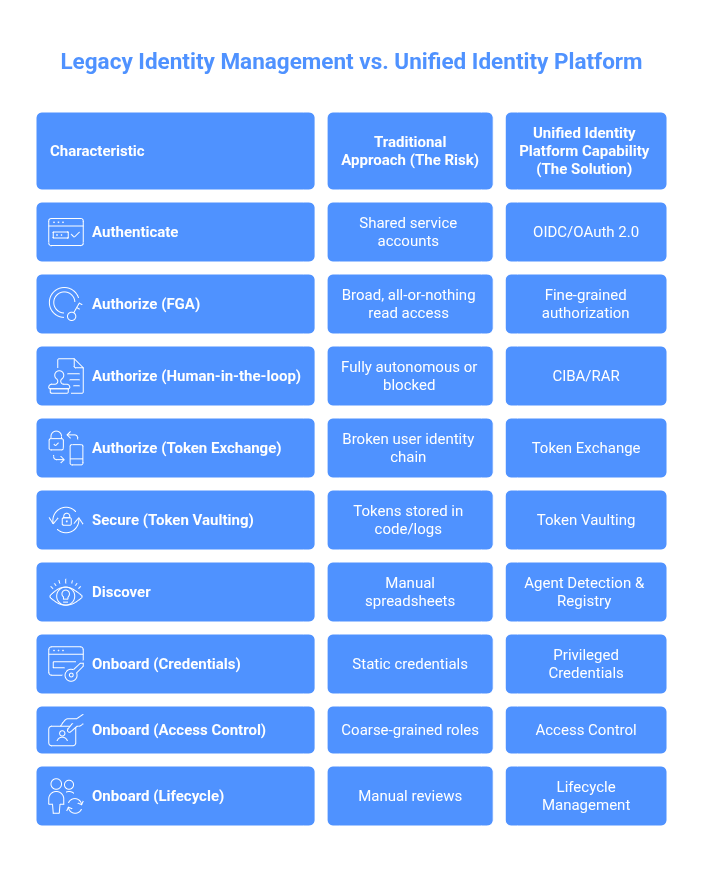
Traditional AI agent management and identity governance models create major security, compliance, and operational challenges for enterprises adopting AI-driven automation. Many organizations still rely on shared service accounts and static credentials, making it difficult to verify user identity, track accountability, or maintain secure AI access management. Without modern AI identity and access management (AI IAM) controls, businesses face increased risks related to unauthorized access, token leakage, Shadow AI, and excessive agent permissions.
One of the biggest risks in traditional AI security architectures is weak authentication and authorization. AI agents often inherit broad, all-or-nothing permissions that expose sensitive enterprise data and APIs far beyond their intended scope. In Retrieval-Augmented Generation (RAG) environments, this lack of fine-grained authorization can lead to unauthorized data exposure and compliance violations. Additionally, downstream API calls frequently break the identity chain between the human user and the AI agent, reducing traceability, auditability, and regulatory compliance.
A modern Unified Identity Platform for AI agents solves these problems by implementing secure identity governance, OAuth 2.0 authentication, OpenID Connect (OIDC), fine-grained authorization (FGA), token exchange, and human-in-the-loop approval workflows. These capabilities ensure that every AI agent session is initiated by a verified human identity and that all actions remain securely tied to the originating user across systems and domains.
Fine-grained authorization enables organizations to enforce least-privilege access controls, ensuring AI agents can only retrieve or process data that users are explicitly authorized to access. This is especially critical for secure enterprise AI applications, RAG pipelines, AI copilots, and autonomous AI workflows handling confidential business information.
Advanced AI governance capabilities such as Client-Initiated Backchannel Authentication (CIBA) and Rich Authorization Requests (RAR) allow organizations to introduce real-time human approval for high-risk or high-value AI actions, including financial transactions, data exports, or privileged system operations. These human-in-the-loop security controls reduce operational risk while maintaining automation efficiency.
Token vaulting and secrets management further strengthen AI cybersecurity by removing sensitive API keys, MCP credentials, and authentication tokens from source code, logs, and application environments. Instead, credentials are securely managed in external vaults, significantly reducing the risk of credential theft, LLM data leakage, and insider threats.
A centralized AI Agent Registry and automated AI discovery capabilities help organizations identify unmanaged or “Shadow AI” systems operating outside governance frameworks. By continuously discovering, registering, and monitoring AI agents, businesses gain complete visibility into their AI ecosystem while improving compliance and reducing security blind spots.
Modern AI onboarding and lifecycle management capabilities also automate credential rotation, access reviews, provisioning, and deprovisioning. This ensures that obsolete AI agents do not retain unnecessary permissions and that access policies remain aligned with least-privilege security principles and zero-trust architecture.
By adopting a Unified Identity Platform for AI security and governance, enterprises can securely scale AI adoption, strengthen compliance, reduce cyber risk, and establish trusted AI operations across cloud, SaaS, APIs, and enterprise systems. These capabilities are essential for organizations implementing enterprise AI, generative AI security, autonomous AI agents, AI governance frameworks, and secure AI infrastructure at scale.
Navigating the EU Regulatory Landscape for AI
- Navigating the EU Regulatory Landscape for AI
As organizations scale AI agents, they must align their identity architecture with the world’s most stringent regulatory frameworks. The pillars of identity security established above are the primary technical mechanisms for achieving compliance.
6.1 The EU AI Act
The EU AI Act classifies AI systems based on risk. Systems classified as “high-risk” face rigorous requirements for transparency and accountability.
- Compliance Link: The Agent Registry (Section 4.1) directly addresses the requirements in Articles 11 and 12 regarding technical documentation and record-keeping. By documenting the agent’s identity, owner, and purpose, and maintaining a centralized log of all actions, enterprises fulfill the Act’s mandate for “traceability” and “explainability” in AI decision-making.
6.2 GDPR Article 22
GDPR Article 22 governs “Automated individual decision-making,” providing data subjects the right not to be subject to a decision based solely on automated processing if it has legal or significant effects.
- Compliance Link: The Human-in-the-loop (CIBA/RAR) pillar is the technical foundation for this requirement. Without CIBA, an enterprise cannot programmatically prove that human intervention occurred for a specific decision. By implementing async approval for high-value actions, organizations satisfy the GDPR requirement for human oversight, ensuring that an agent’s automated logic never bypasses human judgment in sensitive contexts.
6.3 Digital Services Act (DSA) & Age Assurance
The Digital Services Act mandates increased transparency and the protection of minors online, including strict “Age Assurance” requirements.
- Compliance Link: By enforcing OIDC and Verified Human Identity, an agent inherits the pre verified attributes of the human user. If the identity provider (IdP) has verified the user’s age via a passkey or third-party validation, the agent can programmatically enforce age related restrictions. This provides a robust technical mechanism to satisfy the DSA’s protection of minors without requiring the agent to perform its own invasive age checks.
Multi-agent AI systems (MAS) benefits for enterprise
- Strategic Implementation: From Pilot to Production
To move from the vulnerabilities of “Shadow AI” to a secure, compliant architecture, security leaders should adopt this three step roadmap:
- Step 1: Centralize Visibility (Registry): Conduct a comprehensive discovery of all agents in the environment. Onboard them into a central directory with a unique ID, a designated human owner, and a documented purpose to eliminate anonymity.
- Step 2: Enforce Identity-Centric Controls (OIDC/OAuth): Mandate that all agent interactions use standard authentication protocols. Transition from static credentials to token vaulting with 90-day rotation, and implement FGA to tether RAG retrieval to human permissions.
- Step 3: Automate Governance (Lifecycle Management): Deploy automated workflows for the entire agent lifecycle. Ensure that every agent undergoes periodic access reviews and that deprovisioning is immediate upon the completion of its task or a detected threat.
- Conclusion: Identity as the Foundation of AI Confidence
Authenticate: Are your agents linked to verified human identities?
Authorize: Is access limited to what the human user is permitted to see?
Secure: Are tokens stored in a secure vault rather than code?
Discover: Do you have a registry of every agent in your environment?
Govern: Are you rotating credentials and reviewing access automatically?
The age of Agentic AI requires a transformative change in how we view security and compliance. We can no longer treat AI agents as mere applications or blackbox services; we must treat them as outstanding identities.
Identity serves as the central control plane that unifies visibility and governance for both human and non-human actors. By integrating agents into a unified identity framework, organizations can bridge the governance gap, satisfy the stringent demands of global regulations like the EU AI Act and GDPR, and reduce the overall blast radius of AI-driven operations. Security leaders who prioritize this identity-first strategy will empower their organizations to scale AI with the confidence that their innovation is anchored in security and accountability.